
Creating Spaces for Resilience and Joy are Part of the Resistance Playbook: Learnings from Brazil’s Eu Acho é Pouco
Camila Gomes de Lima is one of the core facilitators for Survival Dialogues. She is a human rights and movement lawyer based in Brazil. Camila holds 15 years of experience working with social movements, indigenous peoples, and traditional communities. Her work combines strategic litigation, legal and political advocacy, and engagement with international human rights mechanisms. Camila is also a member of the Global Network of Movement Lawyers.
If you walk anywhere in Latin America, there is a message you will find repeated on its street walls: “organizar la rabia y defender la alegria.” And if you attend Brazil’s Carnaval, you will see banners from the Eu Acho é Pouco Carnaval bloc that share the same motto, “organize rage, defend joy”. Inspired and seeded in internationalism, Movement Law Lab launched Survival Dialogues with the same approach: To defeat authoritarianism, we must organize our rage and defend our joy. This means conducting legal and political analysis and action while sustaining practices that nourish our political imagination. While the authoritarian advance has made the ground feel like it is moving underneath us, communities across the globe have embraced this mantra in response. The United States’ political context makes the fight anything but simple– that is why it’s vital we create and fortify spaces to exchange resilience how-tos and learnings as part of our global resistance strategy.
A core strategy of the authoritarian playbook transcends borders. It relies on the support from one autocrat to another to reinforce their power. As a response, justice-loving communities must do the same: move beyond borders that act as a tool of isolation and embody a collective approach to social resistance. The methods in which communities in the Global South organize their resistance struggle and defend their resilience practices can serve as inspiration. One of these examples comes from northeast Brazil, where we have one of the most joyful popular democratic practices in the world: Carnaval.

Eu Acho é Pouco brought carnival-goers of all ages into the Historic District streets in 2013, dancing to the classic sounds of Olinda Carnival. Foto: Jan Ribeiro/Pref.Olinda
Since its inception, Carnaval’s history is one of resistance and a manifestation of communal joy. Despite our country experiencing one of the darkest times in South American history, we prevailed. In 1977, amidst what would be a two-decade dictatorship rule, Eu Acho é Pouco made its debut in the streets of Olinda, Pernambuco, as one the people’s carnaval blocs. At that time, our country was still facing the brunt of authoritarian rule. So much so, that members of the founding group of the bloc were survivors of political torture of the regime. On the streets of Brazil, Eu Acho é Pouco came alive to give voice to what could not be said out loud and explicitly due to the government censorship and repression at that time. The carnaval bloc gave Brazilians an outlet for joy and dissidence that would outlast any dictator—and remains as vibrant as ever, 50 years later.
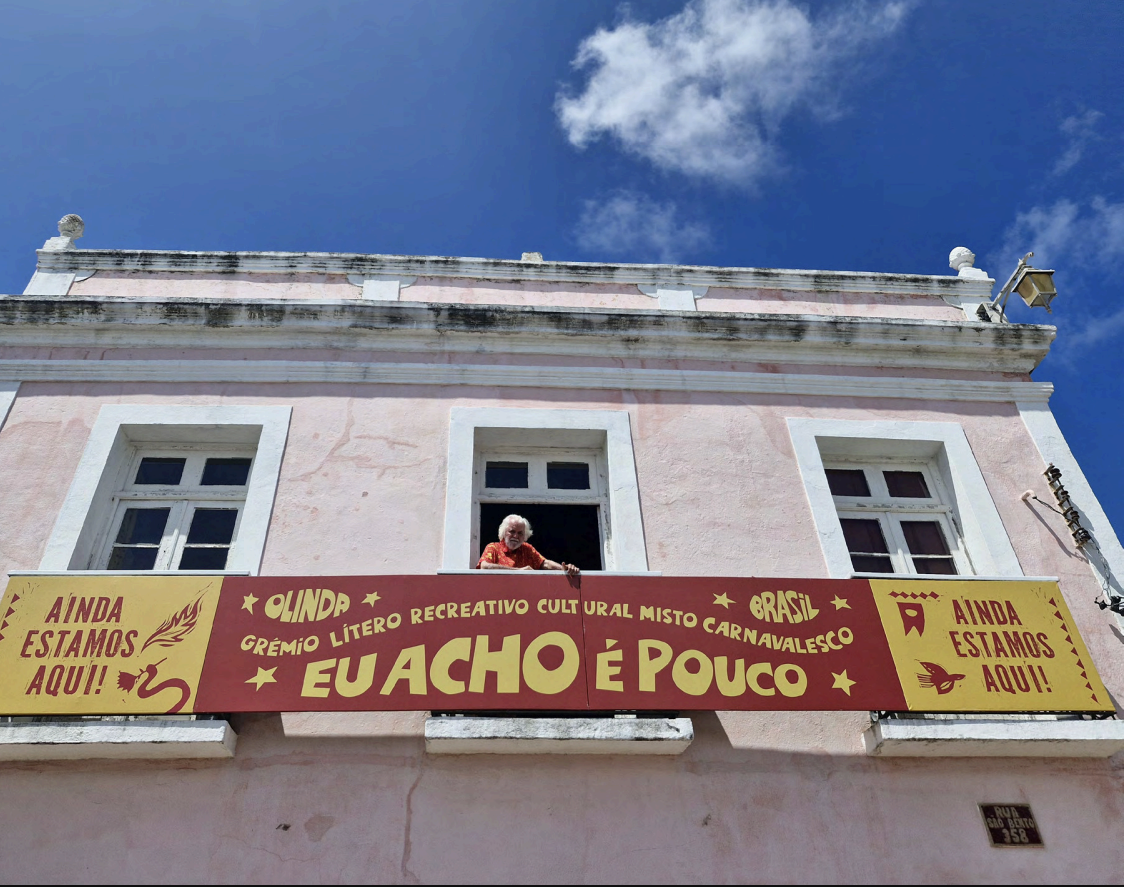
One of the founders of Eu Acho é Pouco is pictured looking down from their balcony.
Carnaval’s Eu Acho é Pouco exemplifies the practice of resistance beyond the traditional formal spaces of democracy. Using street and non-conventional places, they use it to speak and put into practice democratic expression, even when authoritarians attempt to shut down all other traditional avenues. Advancing the authoritarian project requires not only physical repression, but depression of the spirit. Authoritarian consolidation relies on instilling fear, desensitizing civil society to their violence, and normalizing oppression. But it only succeeds if our hope is stolen and change begins to feel out of reach.
Brazil shows the rest of the world that to defeat authoritarian attacks, we need spaces for cultural exchange, collective care, and joy. Amidst the backdrop of social isolation and grief caused from state neglect, violence, and a global pandemic, the Brazilian spirit persisted. Our communities channeled the rage and indignation that formed from the preventable deaths during the COVID-19 pandemic under the Bolsonaro administration onto public spaces. When Bolsonaro was defeated in 2022, the Brazilian people used Carnaval as a vehicle of organizing joy to further embolden our democracy. Later on, Eu Acho é Pouco mobilized during Carnaval to oppose the amnesty bill proposed by the Brazilian Congress for those who took part in the January 2023 coup attempt and ransacking of Brazil’s government buildings.
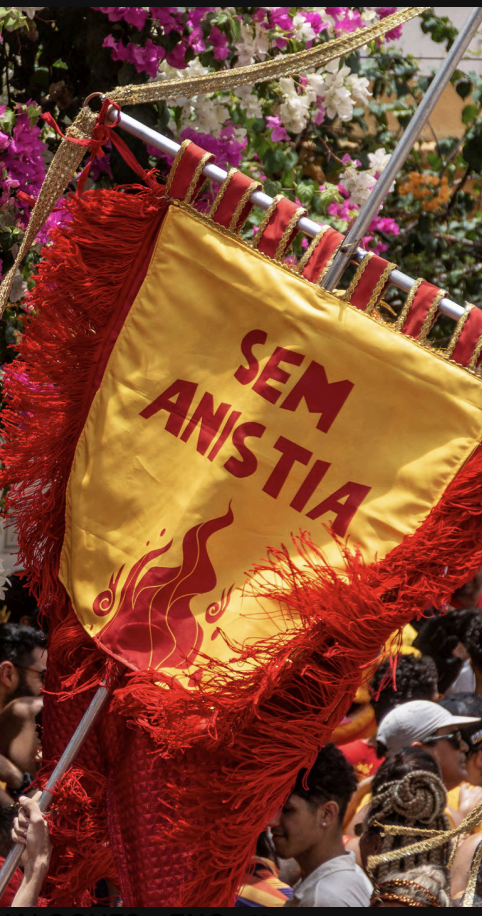
An anti-amnesty banner is held during Carnaval.
In Survival Dialogues, we’re tackling a question bigger than any individual, government, or country: How can we face authoritarianism without letting it narrow our horizon, our political imagination, and our capacity for hope? In Survival Dialogues, we are strengthening our relationships while co-creating a space for shared reflections, restorative practices, and collective learning. Spaces like these allow us to think collectively of the answer. We ask one another questions like, “What was learned during the time of Bolsonaro that can inform the fight in Argentina?”, “How does the fight against xenophobia in South Africa inform the fight in India?”,“Can the tactics in the fight for indigenous land in the Amazon inform the fights against natural resource exploitation in North Africa?” Survival Dialogues give us room to do sense-making of the world while nurturing our spirit to not just survive, but live.
From the Southern Cone to Africa, our fights and struggles are intertwined—and so is our joy. The antidote is not only resistance but also building an enduring joy that fortifies our spirits and lives within our bodies. Ainda estamos aqui (we’re still here). Despite the darkness, we refuse to retreat into the shadows. We must and will protect what authoritarianism wants to take away: our endurance for hope.


.jpg)