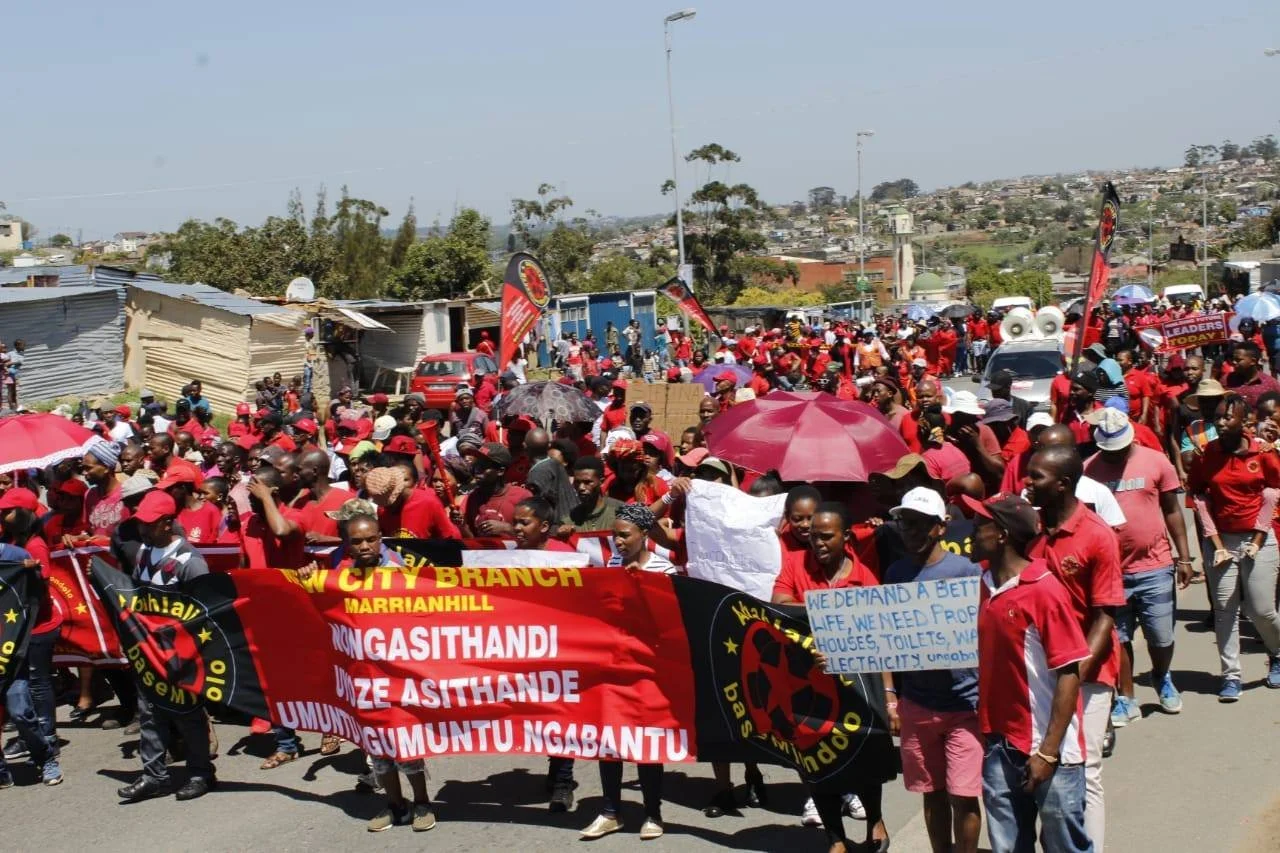
Heavily supported by movement lawyers, members of the Abahlali baseMjondolo social movement take to the streets.
Authoritarianism is on the rise across the globe, and South Africa has been no exception. Our country’s post-apartheid experience shows us just how strong the structural powers and roots found in the appeal of authoritarianism are — and what we will need to defeat them. For movement lawyers in the United States, applying the learnings from your South African peers to your fight against it can make the movement-led and legal strategies more effective and holistic.
In order to address rising authoritarianism, we must first recognize it so we can embrace a “block and build” strategy amongst movement lawyers and social movements alike. This block and build strategy is seeded in the belief that our ultimate objective for civil society is not merely to survive authoritarian times, but to play an active role in building a society in which authoritarianism has less social ground on which to grow.
As movement lawyers, our task is not simply to defend liberal institutions against authoritarian leaders, but rather to understand the social conditions under which authoritarian politics becomes common sense for civil society. The task of movement lawyers, then, is larger than defending the law. It is to help defend and enlarge the democratic capacity of people to govern their own lives.
Democracy cannot survive as a legal architecture floating above an undemocratic political economy; it cannot be seen and felt as only a theory with no material benefit to the masses. It requires organized people, material dignity, and institutions that people experience as their own. And it requires movements capable of transforming legitimate anger into collective power rather than allowing that anger to become hatred of the vulnerable. That is perhaps the deepest lesson from South Africa.
We must recognize how, embedded in the rise of xenophobia in South Africa, there lies continuing legacies of colonialism and inequality that remain unaddressed despite our move to a democracy. March & March, the anti-immigrant vigilante movement that has risen here, has gained popularity and we must understand why. The people whose anger is being mobilized may have very real grievances and we cannot dismiss them. If progressive forces cannot organize around those grievances, reactionary forces will – something already felt not just in South Africa but around the world as authoritative leaders gain traction. Lawyers cannot afford to regard the people attracted to reactionary movements merely as irrational, ignorant or morally defective. That approach is politically inadequate.
As movement lawyers, we must remain accountable to the people whose struggle we support, while, simultaneously, addressing the anger and suffering felt in society. Otherwise, as history has shown, authoritarian projects are more than ready to prey and capitalize on the suffering to come into power. The answer to authoritarianism from below, like what has risen in South Africa’s anti-migrant movement, cannot simply be authoritarianism from above. Nor can it be a liberal politics that asks people to be patient while their material conditions deteriorate.
This is where the South African experience of movement lawyering is instructive. Courts have been used by social movements to defend housing, health, education, protest, labor, and migrant rights. But a court order does not organize a community. A judgment does not automatically produce safety. A constitutional right does not implement itself. Legal victories become durable when they are connected to organized social power. It must be won with democratic power from below, derived from the people. That is where the struggle against authoritarianism ultimately begins: not only in the courtroom or the legislature, but in neighborhoods, workplaces, streets, the community, and the movement.
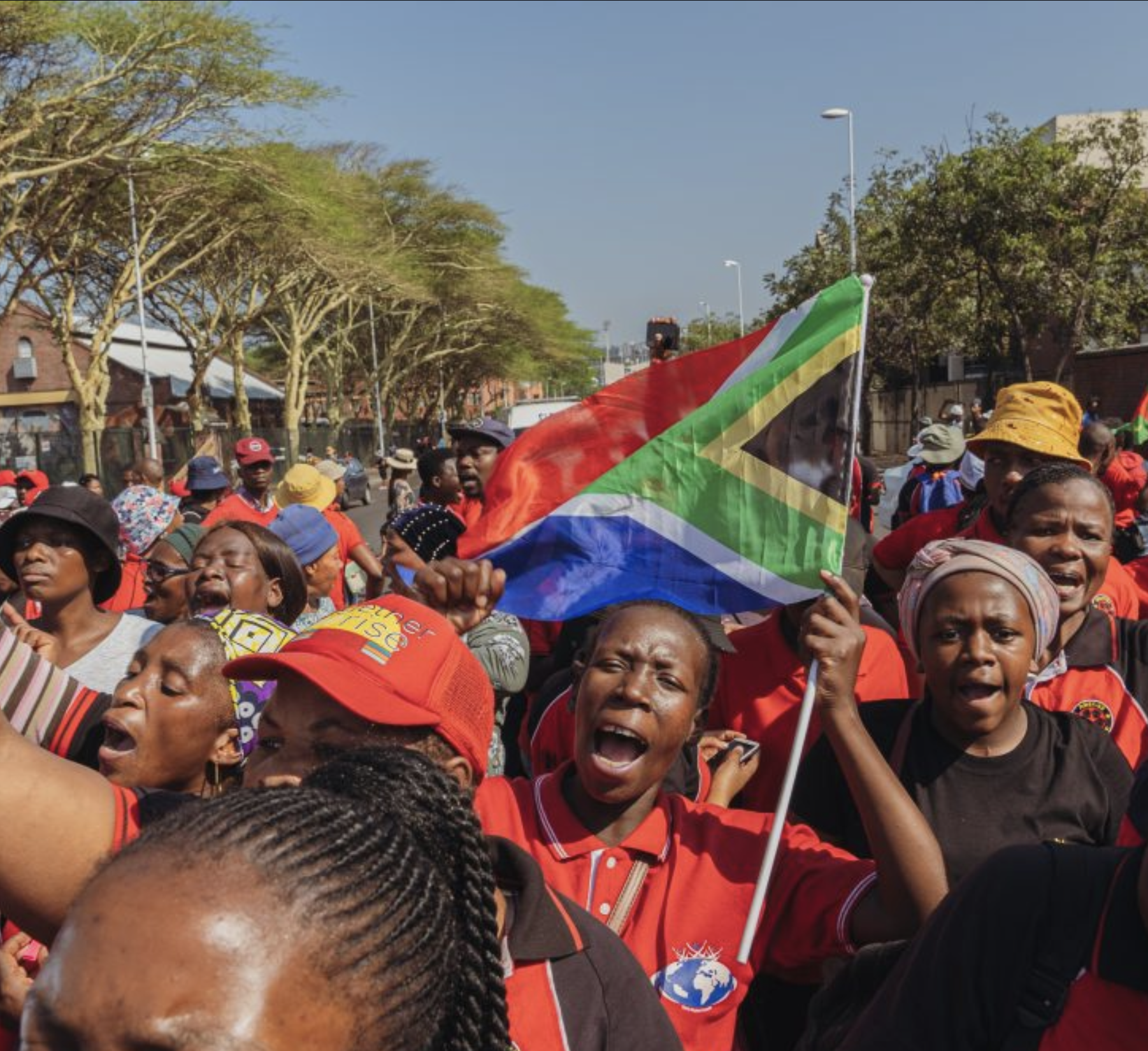
Demonstrators march with the South African flag. As the country's general elections come into play, grassroots mobilizations like this highlight key lessons in how communities organize to defend democracy and combat authoritarianism.
In Durban, South Africa, Abahlali baseMjondolo is exemplifying this practice. The organization, founded in 2005, is part of a democratic movement of 180,000 shack dwellers that is creating spaces for people “from below” to organize into communes, resist evictions, and coordinate legal support for their members fighting for the right to dignity and housing. This is done in combination with popular education focused on helping their members understand root causes of social inequities and form cross-border solidarity with migrant and African solidarity groups. Another example of this is found in Kopanang Africa Against Xenophobia’s (KAAX) work. KAAX formed in response to the growing anti-migrant movement attacks by vigilante anti-migrante groups like Operation Dudula. KAAX began forming broad coalitions connecting grassroots, migrant-led groups, and legal advocacy organizations to embrace a block and build strategy. In 2025, they secured a legal victory against Operation Dudula’s unlawful anti-migrant enforcement agenda. But it doesn’t end there: their legal strategy is connected to building community solidarity to continue turning what they refer to as, “shared vulnerability” into “shared organization” between the struggles of migrants and the South African working class.
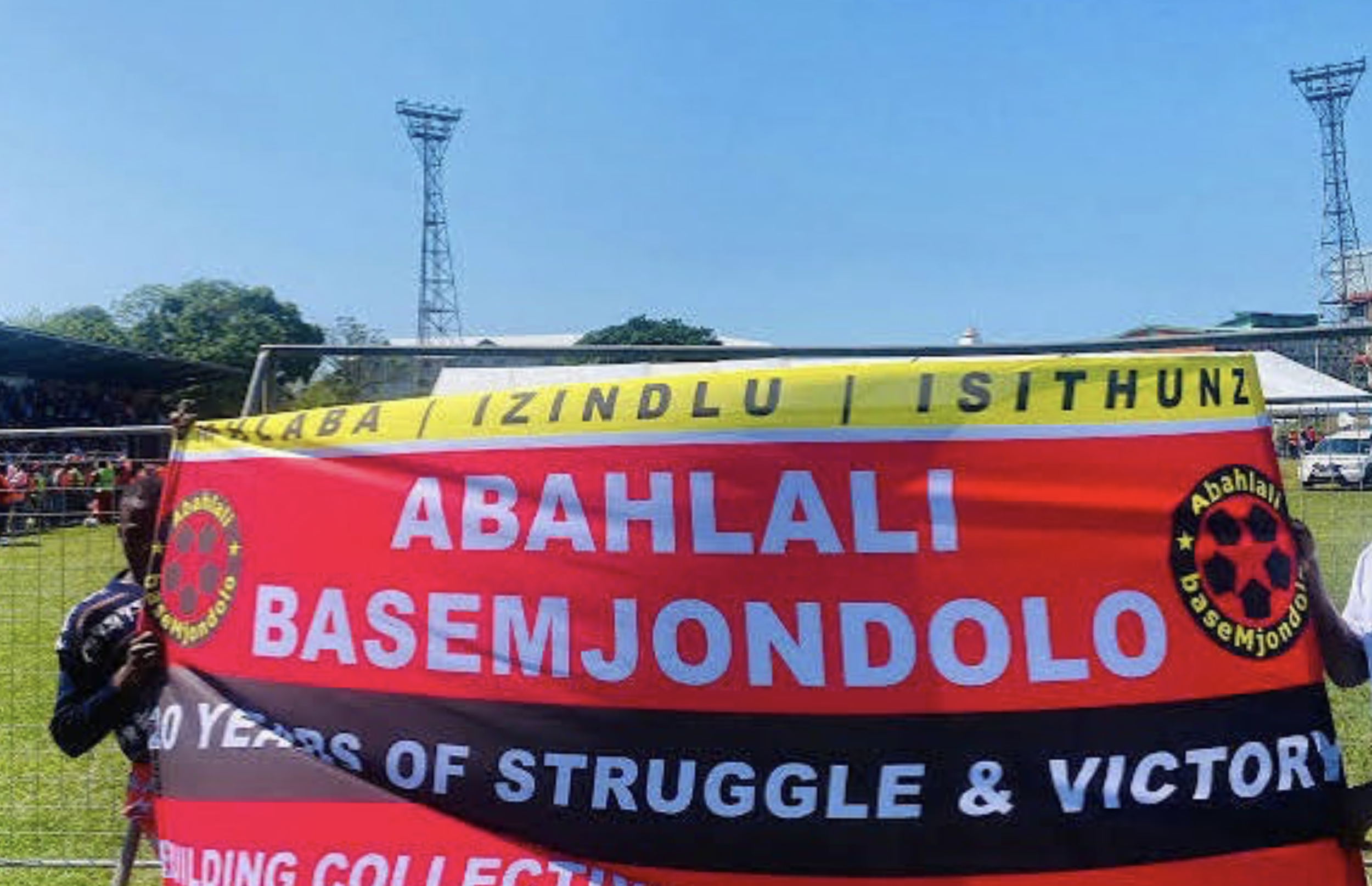
The movement is currently calling for the total rejection of the Draft PIE Amendment Bill, arguing that it weakens established eviction protections and risks criminalizing poverty with severe penalties.
To “block and build” means we fight deportation, xenophobia, repression, evictions, racism, patriarchy, and state violence. And we build unions, cooperatives, community organizations, popular education, migrant solidarity networks, legal defense structures, community assemblies, and institutions of collective care.
The role of the movement lawyer should therefore be neither to replace political organization nor to retreat into professional neutrality. It is to become part of an ecology of democratic struggle: documenting abuses, defending organizers, challenging unlawful state action, protecting vulnerable communities, translating legal rights into popular education, and helping movements understand the terrain on which they are fighting.
The challenge for movement lawyers is legal, political, and organizational. A movement lawyer has to ask: What is the grievance? Who benefits when that grievance is redirected? Who becomes the scapegoat? What institution has failed? What alternative form of collective power could address the underlying problem? How can law assist people to organize themselves beyond just representing them?
For US movement lawyers, the South African experience offers a warning and an invitation.
The warning is that democratic erosion does not begin only when a president openly rejects democracy. It can develop through the everyday normalization of exclusion, punitive policing, racialized nationalism, attacks on migrants, weakening of social protections, and the transfer of coercive authority into the hands of citizens and private organizations.
The invitation is more hopeful. The same conditions that produce authoritarian reaction can also produce democratic counter-power — if people are organized for good. People's anger is not the property of the right. People's fear is not the property of the state. People's demand for dignity is not inherently authoritarian. The political question is who gives these emotions organization, explanation, and direction.
South Africa's experience teaches us that the struggle against authoritarianism must therefore be fought on two terrains simultaneously: We must defend democratic institutions, constitutional rights, and vulnerable communities, but we must also rebuild the social foundations of democracy from below.
And it begins with a simple proposition that South African popular politics has long understood: umntu ngumntu ngabantu — a person is a person through other people. Authoritarianism narrows that circle. Democracy expands it. Our task is to organize the expansion.
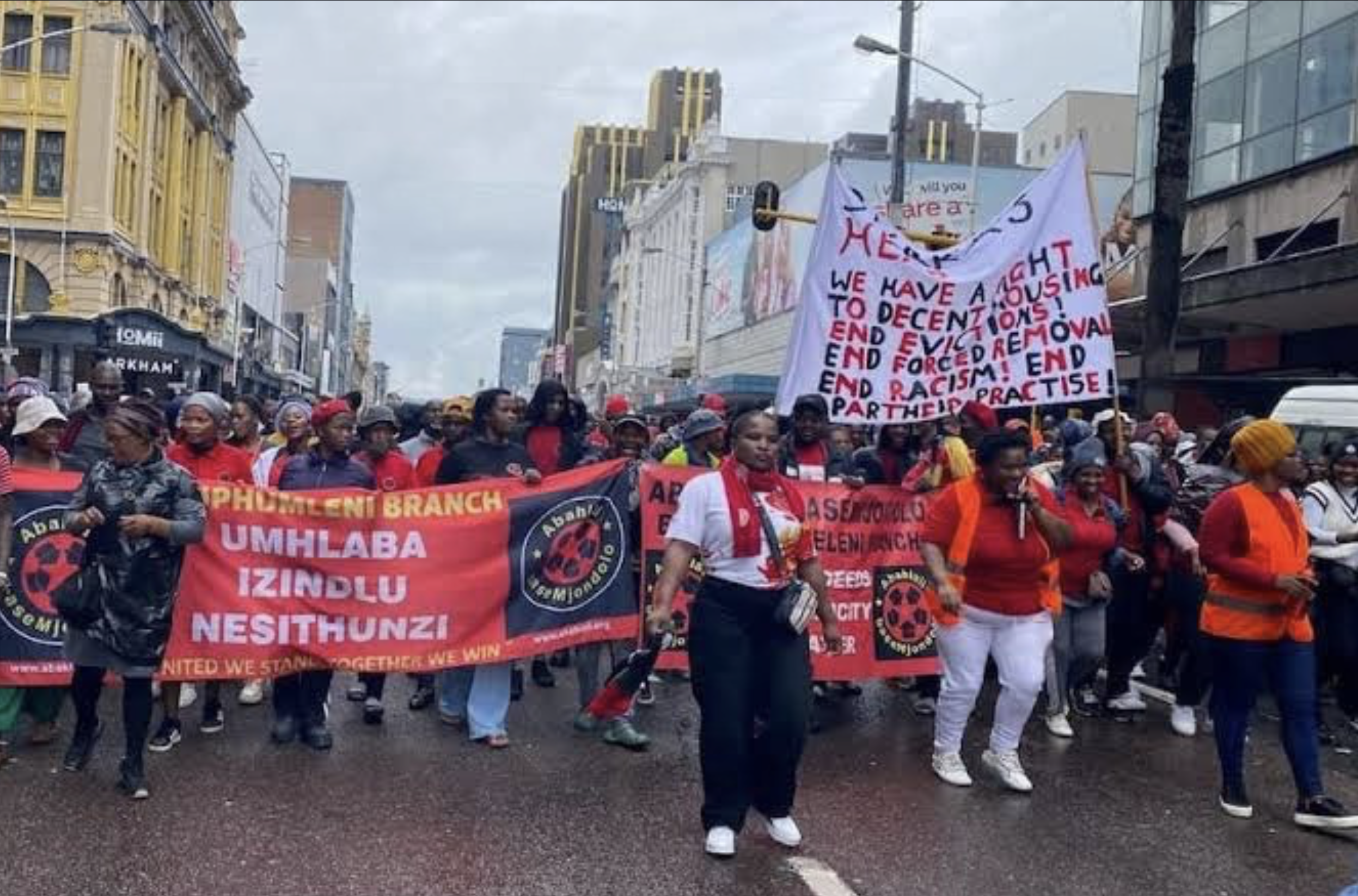
The Abahlali baseMjondolo is a social movement to transition from apartheid-era evictions to true constitutional protection, the movement highlights how restricting land access threatens to deepen the housing crisis and undermine the constitutional promise of dignity for vulnerable communities.
Jara is the Executive Director of the Zabalaza Pathways Institute (www.zabalazapathways.online